


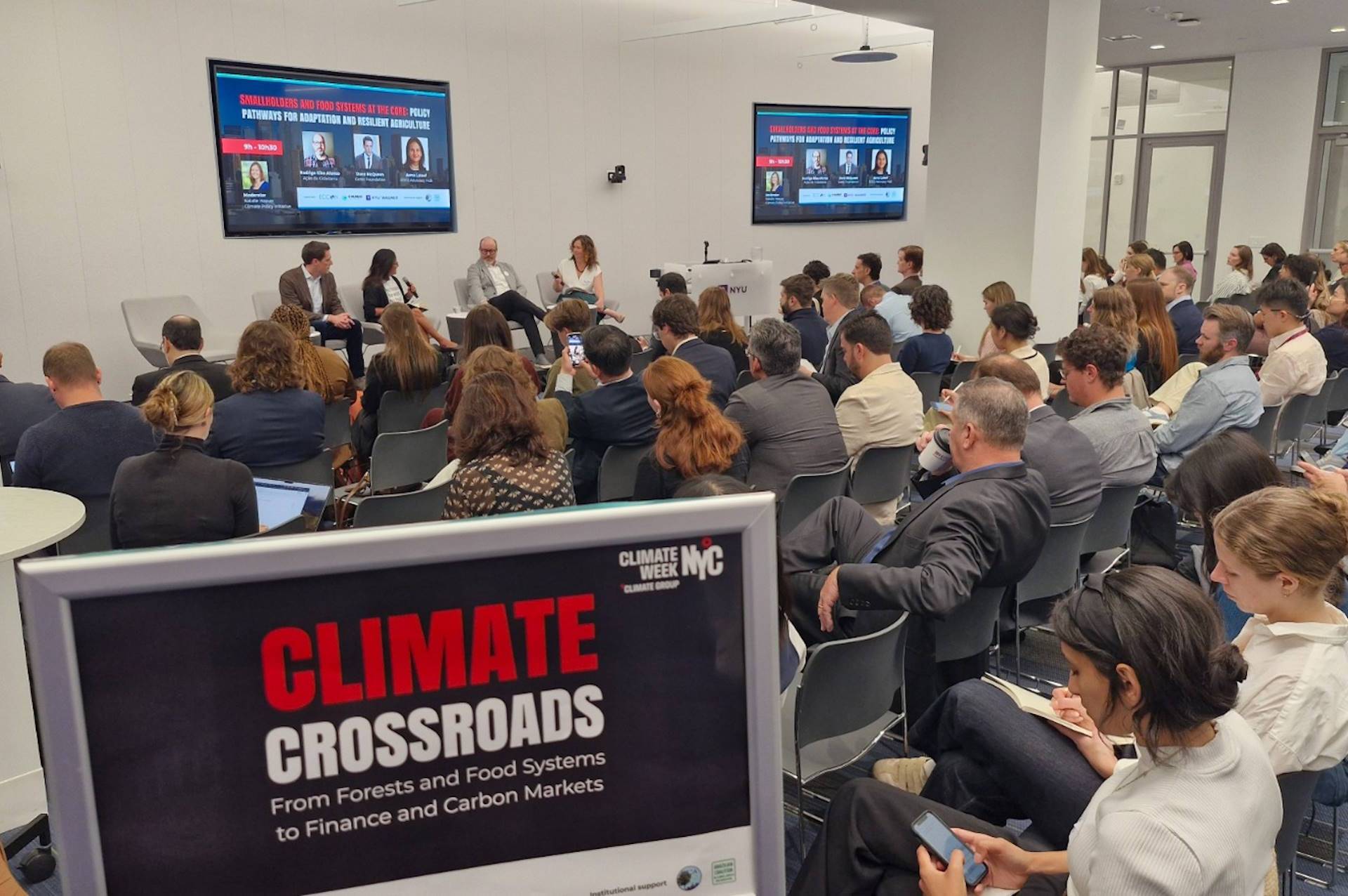
I came back from New York more hopeful than I expected. This year’s Climate Week surprised me in two ways: first, by the intensity of the events, which remained high-energy despite a challenging geopolitical backdrop; and second, by the consistency of a narrative that places Brazil at the center of global solutions for the climate crisis – in ways that benefit both the world and ourselves.
For context, Climate Week happens every September in parallel with the United Nations General Assembly. This year it took place from the 22nd to the 26th. In New York – the world’s financial hub and a global stage for corporate initiatives and thought leadership – Climate Week serves as a litmus test for the willingness of companies and investors to advance mitigation and adaptation actions on climate change. It is also a privileged meeting point for environmental organizations and research institutions.
The main reason for my trip was the Climate Crossroads seminar, organized by us at O Mundo Que Queremos (“The World We Want”) in partnership with New York University (NYU) and ECCON Soluções Ambientais. The event was supported by Ação da Cidadania (a Brazilian NGO fighting hunger), Citrosuco, the Coalition on Climate, Forests and Agriculture (a Brazilian multi-stakeholder coalition), Instituto Arapyaú, Instituto Clima e Sociedade (a major climate philanthropy in Brazil), Pragma Soluções Sustentáveis, S2F Partners, and Vale, one of Brazil’s largest companies. Most importantly, it featured enthusiastic participation from NYU undergraduate and graduate students.
Over the course of a full day, experts, business leaders, and government representatives debated concrete opportunities to tackle the climate crisis, with a strong focus on regenerative agriculture, resilient food systems, and productive forest restoration. These solutions not only reduce emissions but also create jobs, generate income, and attract investment to Brazil. Beyond our own seminar, I was able to join other discussions organized by partner organizations throughout the week.
Some feared a weakening of global climate engagement, given signs of backtracking from certain governments and companies. Yet in New York it became clear that the transition to a low-carbon economy is now inevitable. Pressures from investors, consumers, and regulators have consolidated commitments that will not be rolled back. Moreover, the impacts of climate change are already here, which has elevated the importance of adaptation – preparing cities, infrastructure, and above all agriculture for new patterns of rainfall, drought, and extreme events.
And this is precisely where Brazil’s unique opportunity comes into play. As one of the world’s largest producers and exporters of food and energy, Brazil can lead the transition to innovative regenerative agriculture practices. This means engaging both smallholders and large producers in systems that restore ecosystem services: improving water quality, protecting springs, maintaining rainfall cycles, enhancing biodiversity, and restoring native vegetation and forests. These practices deliver productivity gains and market value while making farmers more resilient to climate shocks.
Another clear opportunity lies in forest regeneration. Estimates point to as much as 80 million hectares (197 million acres) available for recovery in the Amazon. Whether through passive regeneration (protecting areas from fire and letting nature restore itself) or active regeneration (tree planting and community-based restoration efforts), Brazil can generate quality jobs in regions with limited economic alternatives. At the same time, this work helps meet the urgent global need to capture carbon through photosynthesis in tropical forests — an indispensable complement to reducing emissions through clean energy and sustainable transport.
This vision echoed across several panels and meetings during Climate Week, including among American investors. Brazil has before it not only an environmental duty but also a strategic chance to position itself as a protagonist in the emerging climate economy. As Bruno Laskowsky, Partner and Managing Director at Yvy Capital, a fund specialized in green transition, put it during our seminar: “Brazil has the opportunity to make carbon one of the key items in its trade balance. People here in the United States already understand that Brazil is a key actor for investments in carbon credits and forests. I believe Brazilians will see this opportunity too.”
Some entrepreneurs in the Amazon are already ahead of the curve. Denis Minev, president of Bemol, the largest retail chain in the Amazon region, also spoke at Climate Crossroads: “All that’s needed is to establish a price for forest carbon and make this mechanism available to local entrepreneurs. It’s the greatest economic opportunity of my generation.”
Brazil’s message in New York was clear: our natural capital and innovative practices can be engines of prosperity, resilience, and global climate stability.
*This opinion piece is the responsibility of its authors and does not necessarily reflect the views of ((o))eco.
This story was originally published in Portuguese. The translation was done with the assistance of Artificial Intelligence, with final review by the journalist Fabiani Matos
-

Alexandre Mansur
Diretor de projetos do Mundo Que Queremos →
Se o que você acabou de ler foi útil para você, considere apoiar
Produzir jornalismo independente exige tempo, investigação e dedicação — e queremos que esse trabalho continue aberto e acessível para todo mundo.
Por isso criamos a Campanha de Membros: uma forma de leitores que acreditam no nosso trabalho ajudarem a sustentá-lo.
Seu apoio financia novas reportagens, fortalece nossa independência e permite que continuemos publicando informação de interesse público.
Escolha abaixo o valor do seu apoio e faça parte dessa iniciativa.
Leia também
How we will cultivate the future
Regenerative agriculture is the best strategic response to our food security and the rise of chronic diseases →
Protecting the forest means protecting capital
Understanding the Amazon and its unique characteristics is fundamental to the success of investments in the region →
How Gold Mining Threatens the Amazon – In a Way, With the State’s Approval
Extraction deemed “legal” by outdated regulations functions as a driver of socio-environmental destruction just as severe as illegal mining →